Beef production has an outsized climate impact compared to other foods. Photo by SDA Natural Resources Conservation Service/Wikimedia Commons
The global food system’s environmental impact is large and growing. Nearly a quarter of all planet-warming greenhouse gas emissions come from food production and associated land-use change. And as incomes rise and more people move to cities, consumption of meat and dairy – foods with outsized climate impacts – is on the rise.
The below visualization shows trends in meat consumption from 1961 to today, and what’s likely to happen through 2050 if current patterns continue.
Between 2010 and 2050, global meat and dairy consumption is on a course to increase by nearly 70 percent, with beef consumption increasing by more than 80 percent.
The Climate Impact of the Foods We Eat
The Intergovernmental Panel on Climate Change (IPCC), a group of the world’s foremost climate scientists, laid out in a report released last week the dangers of breaching the 1.5°C and 2°C temperature thresholds. The relationship between food production and climate change is a two-way street: With 2°C of warming, seas will rise by nearly half a meter, rainfall patterns will change, crop yields in the tropics will decrease, and harvests from marine fisheries will decline. The world will still face serious climate impacts with 1.5°C of warming, but significantly less so than with 2°C.
Climate change deals with the weather. It is a change in the weather pattern over a long period of time. Everyone knows about climate change, or global warming, because it has been quite rampant nowadays. Climate change affects all of our lives and the life of our planet. Not only does it affect humans, but plants and animals as well. Climate change has a big negative impact on our natural resources. We need to make a change in order for global warming to slowly decease. To do that, we should first learn what the causes of climate change are.
Causes of Climate Change
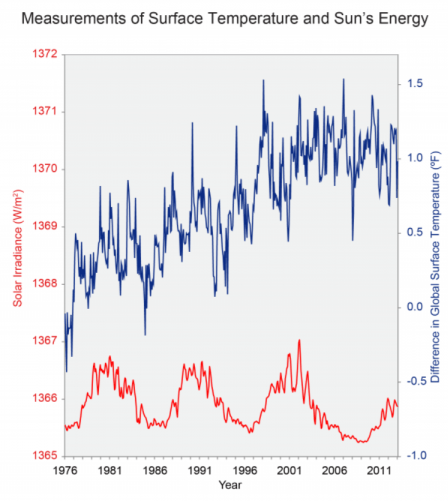
Solar variabiltity – the sun’s energy output is constantly changing, causing the earth to become hotter. The sun is our major source of heat, but this heat is becoming warmer due to the irradiance of the sun’s emissions.
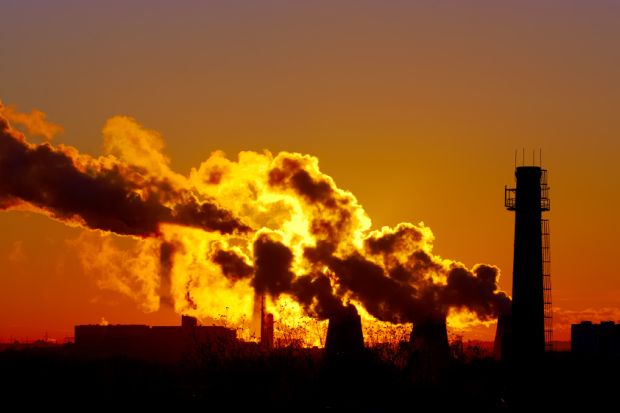
Human Activities – Human activities like driving vehicles, burning fossil fuels, clearing land, and agriculture highly contribute to climate change. Driving vehicles and burning fossil fuels releases pollution and smog into the atmosphere. When fossil fuels are burned, carbon dioxide, a greenhouse gas, is released into the air and it gets trapped in earth’s atmosphere causing the earth to heat up. The clearing of land and agriculture are causes of climate change because when land is cleared of trees and plants, there will be nothing to absorb the excess carbon dioxide in the air and turn it into oxygen for us to breathe.
Greenhouse Gases – Due to human activities, several greenhouse gases are emitted into the earth’s atmosphere. The concentration of these greenhouse gases in the atmosphere causes the “greenhouse effect” to happen. The “greenhouse effect” is term for when heat or radiation from the sun gets trapped in the atmosphere of the planet and causes it to become warmer. These greenhouse gases cause the same thing to happen and that’s why climate change is becoming a big problem.
How to Suppress the Effects of Climate Change
Use renewable energy sources – Try switching to clean energy sources like: solar, wind, or hydro power.
Be energy efficient – Unplug any appliances that are not being used. Turn the lights off when you’re not using it. Save energy as best as you can.
Plant trees – Replace the trees that have been cut down for clearing of land and manufacturing purposes.
Reduce, reuse, recycle – Abide by the three R’s to decrease the amount of pollution in the air as well as in the ocean.
Carpool, take the bus, or walk – By doing these things, we can lessen the amount of pollution and smog emissions in the atmosphere.
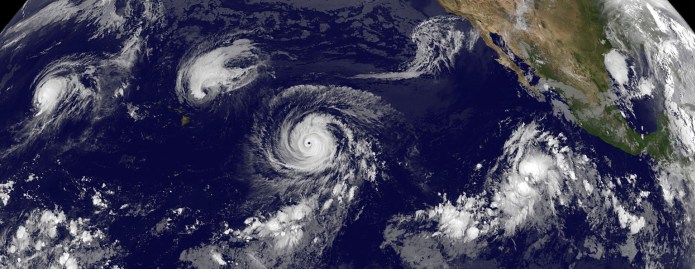
(Four Tropical Cyclones Across the Entire Pacific Ocean: from nasa.gov)
Trying to isolate the human influence from everything else that is going on can be really hard, especially for tropical cyclones. They’re super complex and the quality of the historical data we have for them isn’t great. We do have physics, though.
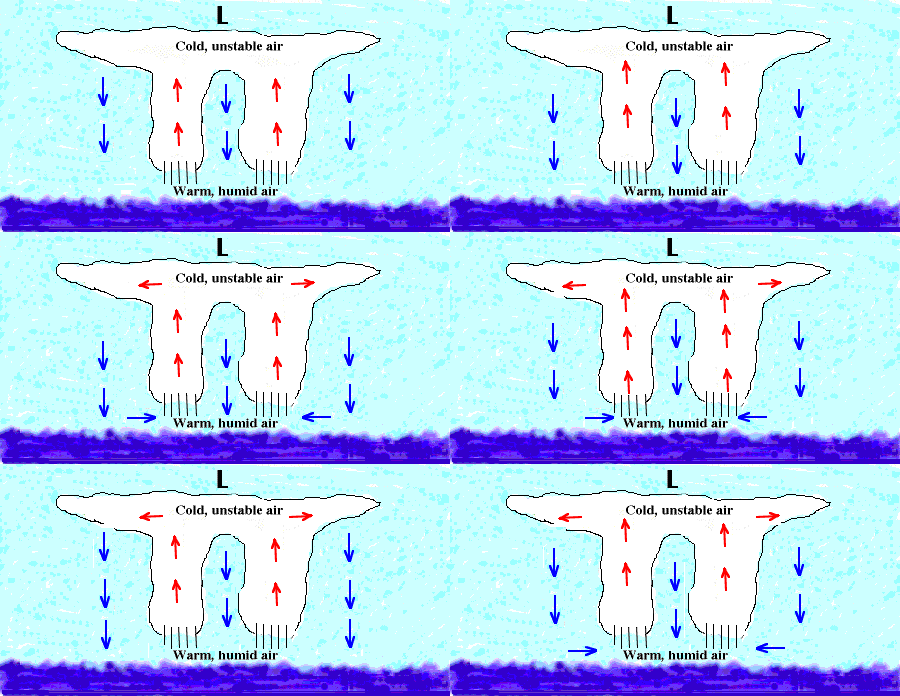
Tropical Cyclones are driven by the transfer of heat from the sea to the air through evaporation. The storm’s maximum possible wind speed, or its potential intensity, depends in part on how warm the ocean is.
(An illustration on how tropical cyclones are formed :from atmos.uiuc.edu)
And of course, we’re warming the ocean. So researchers expect intense tropical cyclones to become frequent if we continue to warm the planet. The cyclones of the future will be wetter. Just imagine how many more longer class suspensions it will take if this goes on.
And that trend of wetter storms isn’t just for tropical cyclones. Heavy precipitation events from other types of storms have been increasing. Warmer air can take up more water before it dumps it back down on us.
All of this means climate change worsens floods, but it’s not our destiny to hurt ourselves like this. It depends on what we choose to do now.
Hello everyone, today we are going to tackle about the effects of climate change and ways on how to suppress climate change. As we all know that climate change is a contagious and unsolutioned problem in the world. In today’s generation climate change has continuing to grow or in other word is that it got worst problem in our world. So here are some examples and ways on how to suppress climate change;
The climate change phenomenon refers to seasonal changes over a long period with respect to the growing accumulation of greenhouse gases in the atmosphere. Tackling this phenomenon is of utmost importance given the pivotal role that climate plays in the formation of natural ecosystems and the human economies and civilizations on which they are based.
Recent studies have shown that human activities since the beginning of the industrial revolution – manifested in fossil fuel consumption for power generation, land deforestation for agriculture, and urban expansion – have contributed to an increase in the concentration of carbon dioxide in the atmosphere by as much as 40%, from about 280 parts per million in the pre-industrial period, to 402 parts per million in 2016, which in turn has led to global warming.
Causes of Climate change
The greenhouse effect causes the atmosphere to retain heat
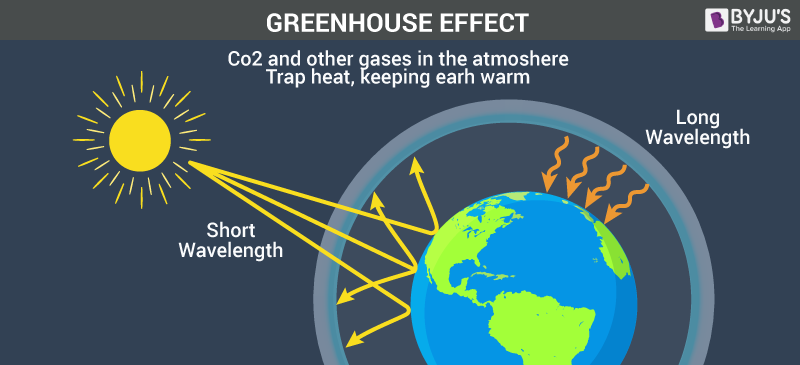
When sunlight reaches Earth’s surface, it can either be reflected back into space or absorbed by Earth. Once absorbed, the planet releases some of the energy back into the atmosphere as heat (also called infrared radiation). Greenhouse gases like water vapor (H2O), carbon dioxide (CO2), and methane (CH4) absorb energy, slowing or preventing the loss of heat to space. In this way, GHGs act like a blanket, making Earth warmer than it would otherwise be. This process is commonly known as the “greenhouse effect.”
Changes in the sun’s energy affect how much energy reaches Earth’s system
Climate is influenced by natural changes that affect how much solar energy reaches Earth. These changes include changes within the sun and changes in Earth’s orbit.
Changes occurring in the sun itself can affect the intensity of the sunlight that reaches Earth’s surface. The intensity of the sunlight can cause either warming (during periods of stronger solar intensity) or cooling (during periods of weaker solar intensity). The sun follows a natural 11-year cycle of small ups and downs in intensity, but the effect on Earth’s climate is small.[1]
Changes in the shape of Earth’s orbit as well as the tilt and position of Earth’s axis can also affect the amount of sunlight reaching Earth’s surface.
Changes in reflectivity affect how much energy enters Earth’s system
When sunlight reaches Earth, it can be reflected or absorbed. The amount that is reflected or absorbed depends on Earth’s surface and atmosphere. Light-colored objects and surfaces, like snow and clouds, tend to reflect most sunlight, while darker objects and surfaces, like the ocean, forests, or soil, tend to absorb more sunlight.
The term albedo refers to the amount of solar radiation reflected from an object or surface, often expressed as a percentage. Earth as a whole has an albedo of about 30%, meaning that 70% of the sunlight that reaches the planet is absorbed.[3] Absorbed sunlight warms Earth’s land, water, and atmosphere.
Ways on how to suppress climate change.
Power your home with renewable energy.
Choose a utility company that generates at least half its power from wind or solar and has been certified by Green-e Energy, an organization that vets renewable energy options. If that isn’t possible for you, take a look at your electric bill; many utilities now list other ways to support renewable sources on their monthly statements and websites.
Invest in energy-efficient appliances.
Since they were first implemented nationally in 1987, efficiency standards for dozens of appliances and products have kept 2.3 billion tons of carbon dioxide out of the air. That’s about the same amount as the annual carbon pollution coughed up by nearly 440 million cars. “Energy efficiency is the lowest-cost way to reduce emissions,” Haq says. When shopping for refrigerators, washing machines, and other appliances, look for the Energy Star label. It will tell you which are the most efficient.
Reduce water waste.
Saving water reduces carbon pollution, too. That’s because it takes a lot of energy to pump, heat, and treat your water. So take shorter showers, turn off the tap while brushing your teeth, and switch to WaterSense-labeled fixtures and appliances. The EPA estimates that if just one out of every 100 American homes were retrofitted with water-efficient fixtures, about 100 million kilowatt-hours of electricity per year would be saved—avoiding 80,000 tons of global warming pollution.
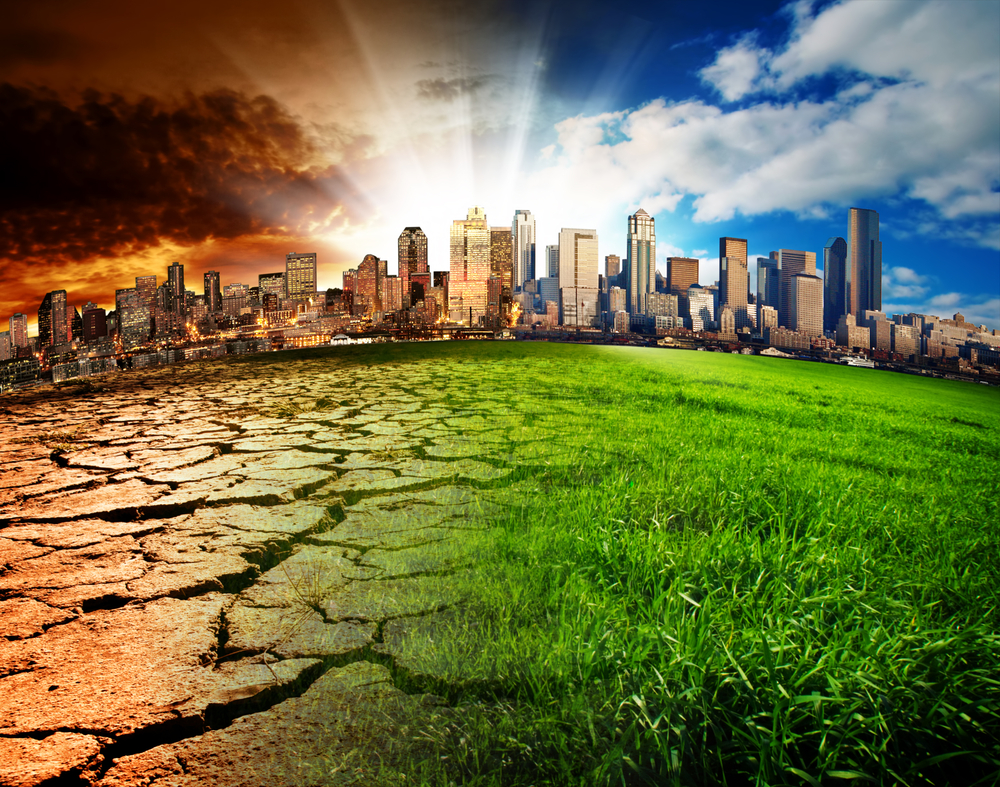
Climate change, also called global warming, it has a big impact in our world, refers to the rise in average surface temperatures on Earth. An overwhelming scientific consensus maintains that climate change is due primarily to the human use of fossil fuels, which releases carbon dioxide and other greenhouse gases into the air. The gases trap heat within the atmosphere, which can have a range of effects on ecosystems, including rising sea levels, severe weather events, and droughts that render landscapes more susceptible to wildfires.
Causes of Climate Change
Volcano Eruption
Volcanoes can impact climate change. During major explosive eruptions huge amounts of volcanic gas, aerosol droplets, and ash are injected into the stratosphere. Injected ash falls rapidly from the stratosphere — most of it is removed within several days to weeks — and has little impact on climate change. But volcanic gases like sulfur dioxide can cause global cooling, while volcanic carbon dioxide, a greenhouse gas, has the potential to promote global warming.
Increased burning of fossil fuels contributes to climate change
Rising sea levels due to the melting of the polar ice caps (again, caused by climate change) contribute to greater storm damage; warming ocean temperatures are associated with stronger and more frequent storms; additional rainfall, particularly during severe weather events, leads to flooding and other damage; an increase in the incidence and severity of wildfires threatens habitats, homes, and lives; and heat waves contribute to human deaths and other consequences.
Deforestation
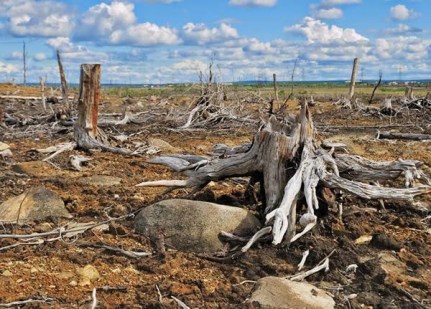
Many plants and animals live in forest, if we continue deforestation million of species will loss their habitat. Trees are very helpful to us it give us shelter it produces oxygen, intercept airborne particulates, and reduce smog, enhancing a community’s respiratory health. Avoid cutting trees because trees are useful.
Ways on how to Surpress the effects of Global Warming
To stop climate change we should use energy wisely by unpluging computers, TVs and other electronics when you’re not using them, avoid deforestation, ride bike instead of riding car, we should learn how to clean our surroundings by helping each other.Its never too late for us to save mother earth,the goodnews is you are not alone. Were fighting like our life depends on it because we do.
Spend Time in Nature. Consume less, waste less, enjoy life more.
Why do you think that our surrounding nowadays is so hot? Why is that the ices of the Antartica are slowly melting? Why is that the weather is changing from time to time that we hardly predict it? Well, climate change is the cause. So what is climate change? Climate change also called global warmingis the current increase in temperature of the Earth’s surface (both land and water) as well as it’s atmosphere. Average temperatures around the world have risen by 0.75°C (1.4°F) over the last 100 years about two thirds of this increase has occurred since 1975.12 In the past, when the Earth experienced increases in temperature it was the result of natural causes but today it is being caused by the accumulation of greenhouse gases in the atmosphere produced by human activities.
Here are some of it’s causes:
The Greenhouse Effect: natural and enhanced
The ‘natural’ greenhouse effect makes life as we know it possible on Earth. Without this effect, the average temperature would be about – 18°C (well below the freezing point of water), rather than its current 14°C.
Earth’s surface temperature is determined by the radiative balance, the net difference between the energy gained from incoming sunlight and the amount lost into space as infrared radiation. The Earth’s atmosphere acts like a transparent blanket, letting in light but trapping some of the heat it generates. Without an atmosphere, all of this energy would be lost to space.
This natural effect relies on ‘greenhouse’ gases in our atmosphere allowing sunlight to pass through, and trapping some of the resulting heat energy that radiates back up from the Earth’s surface.
The greenhouse effect describes how certain gases in our atmosphere increase the temperature on Earth’s surface by preventing some of the energy radiating from the planet’s surface from being lost into space (UNEP/GRID-Arendal).
Greenhouse Gases
The most important greenhouse gases are water vapour and carbon dioxide (CO2). Both are present at very small concentrations in the atmosphere. Water vapour varies considerably in space and time because it has a short ‘lifetime’ in the atmosphere. Because of this variation, it is difficult to measure globally averaged water vapour concentration. Carbon dioxide has a much longer lifetime and is well mixed throughout the atmosphere. The current concentration is about 0.04 per cent. Other greenhouse gases in our atmosphere include methane, nitrous oxide and chlorofluorocarbons.
Water vapour accounts for about half the present-day greenhouse effect, but its concentration in the atmosphere is not influenced directly by human activities. The amount of water in the atmosphere is related mainly to changes in the Earth’s temperature. For example, as the atmosphere warms it is able to hold more water. Although water vapour absorbs heat, it does not accumulate in the atmosphere in the same way as other greenhouse gases; it tends to act as part of a feedback loop rather than being a direct cause of climate change. (Read more about feedback in Climate systems).
Carbon dioxide is the largest single contributor to human-induced climate change. NASA describes it as ‘the principal control knob that governs the temperature of Earth’. Although other factors (such as other long-lived greenhouse gases, water vapour and clouds) contribute to Earth’s greenhouse effect, carbon dioxide is the dominant greenhouse gas that humans can control in the atmosphere.
The two most abundant gases in the atmosphere are nitrogen (comprising 78 per cent of the dry atmosphere) and oxygen (21 per cent), but they have almost no greenhouse effects.
Carbon dioxide and the carbon cycle
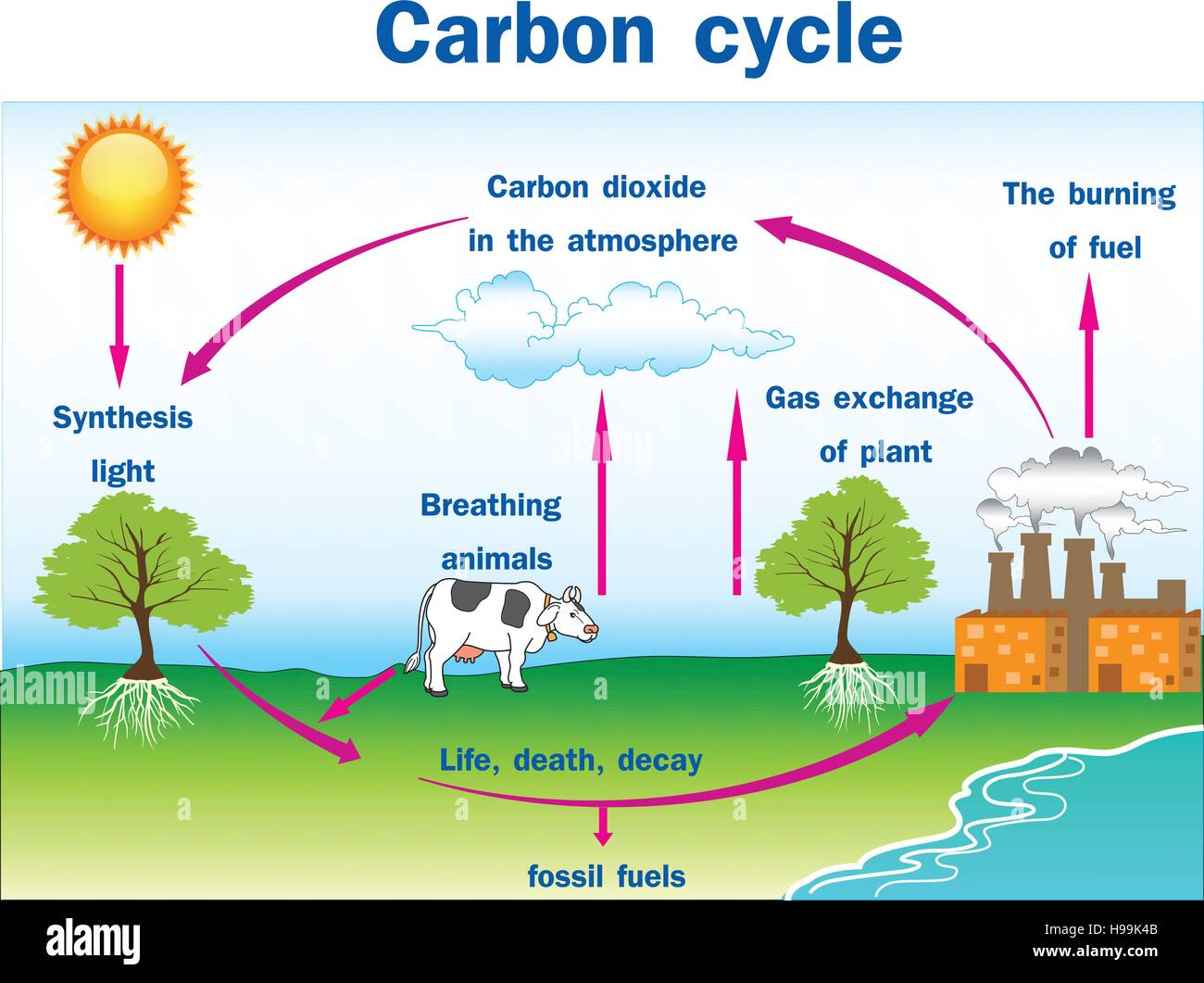
All living organisms contain carbon, as do gases (such as carbon dioxide) and minerals (such as diamond, peat and coal). The movement of carbon between large natural reservoirs in rocks, the ocean, the atmosphere, plants, soil and fossil fuels is known as the carbon cycle.
The carbon cycle includes the movement of carbon dioxide:
into and out of our atmosphere
between the atmosphere, plants and other living organisms through photosynthesis, respiration and decay
between the atmosphere and the top of the oceans.
The carbon cycle, showing the movement of carbon between land, the atmosphere and the oceans. Yellow numbers are natural fluxes and red numbers are human contributions in gigatonnes of carbon per year. White numbers indicate stored carbon (The Carbon Cycle , NASA).
Increases in greenhouse gases due to human activities
Carbon dioxide is being added to the atmosphere faster than it can be removed by other parts of the carbon cycle.
Since the Industrial Revolution there has been a large increase in human activities such as fossil fuel burning, land clearing and agriculture, which affect the release and uptake of carbon dioxide.
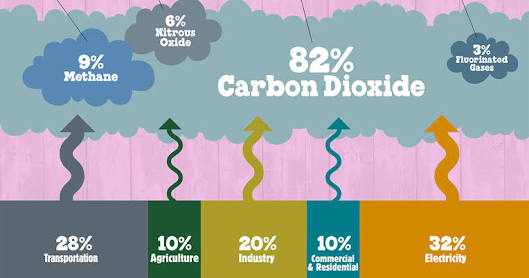
According to the most recent Emissions Overview, carbon dioxide and other greenhouse gases are produced in NSW by the following activities or sources:
stationary energy sources, such as coal-fired power stations (47 per cent)
transport (18 per cent)
coal mines (12 per cent)
agriculture (11 per cent)
land use (7 per cent)
land change (3 per cent)
waste (2 per cent).
Carbon dioxide released into the atmosphere from burning fossil fuels carries a different chemical fingerprint from that released by natural sources such as respiration and volcanoes. This makes it possible to identify the contribution of human activity to greenhouse gas production.
Ways on how to suppress the effects of climate change
It is not yet to late to do an action. CLIMATE CHANGE can be CHANGE. It is in the way that we have to realize are wrongdoings and make it right. We are human beings with the knowledge of what is morally right and wrong. So, we have to take an actions to those things that we damage and destroy in the land where we live. We have to take care and love our mother nature to suppress all the effects of the climate change.
Here are some of the ways on how to make and end of the effects of climate change:
Speak up!
What’s the single biggest way you can make an impact on global climate change? “Talk to your friends and family, and make sure your representatives are making good decisions,” Haq says. By voicing your concerns—via social media or, better yet, directly to your elected officials—you send a message that you care about the warming world. Encourage Congress to enact new laws that limit carbon emissions and require polluters to pay for the emissions they produce. “The main reason elected officials do anything difficult is because their constituents make them,” Haq says. You can help protect public lands, stop offshore drilling, and more here.
Power your home with renewable energy.
Choose a utility company that generates at least half its power from wind or solar and has been certified by Green-e Energy, an organization that vets renewable energy options. If that isn’t possible for you, take a look at your electric bill; many utilities now list other ways to support renewable sources on their monthly statements and websites.
Weatherize, weatherize, weatherize.
“Building heating and cooling are among the biggest uses of energy,” Haq says. Indeed, heating and air-conditioning account for almost half of home energy use. You can make your space more energy efficient by sealing drafts and ensuring it’s adequately insulated. You can also claim federal tax credits for many energy-efficiency home improvements.
Invest in energy-efficient appliances.
Since they were first implemented nationally in 1987, efficiency standards for dozens of appliances and products have kept 2.3 billion tons of carbon dioxide out of the air. That’s about the same amount as the annual carbon pollution coughed up by nearly 440 million cars. “Energy efficiency is the lowest-cost way to reduce emissions,” Haq says. When shopping for refrigerators, washing machines, and other appliances, look for the Energy Star label. It will tell you which are the most efficient.
Reduce water waste.
Saving water reduces carbon pollution, too. That’s because it takes a lot of energy to pump, heat, and treat your water. So take shorter showers, turn off the tap while brushing your teeth, and switch to WaterSense-labeled fixtures and appliances. The EPA estimates that if just one out of every 100 American homes were retrofitted with water-efficient fixtures, about 100 million kilowatt-hours of electricity per year would be saved—avoiding 80,000 tons of global warming pollution.
Actually eat the food you buy—and make less of it meat.
Approximately 10 percent of U.S. energy use goes into growing, processing, packaging, and shipping food—about 40 percent of which just winds up in the landfill. “If you’re wasting less food, you’re likely cutting down on energy consumption,” Haq says. And since livestock products are among the most resource-intensive to produce, eating meat-free meals can make a big difference, too.
Buy better bulbs.
LED lightbulbs use up to 80 percent less energy than conventional incandescents. They’re also cheaper in the long run: A 10-watt LED that replaces your traditional 60-watt bulb will save you $125 over the lightbulb’s life.
Pull the plug(s).
Taken together, the outlets in your home are likely powering about 65 different devices – an average load for a home in the U.S. Audio and video devices, cordless vacuums and power tools, and other electronics use energy even when they’re not charging. This “idle load” across all U.S. households adds up to the output of 50 large power plants in the U.S. So don’t leave fully charged devices plugged into your home’s outlets, unplug rarely used devices or plug them into power strips and timers, and adjust your computers and monitors to automatically power down to the lowest power mode when not in use.
Drive a fuel-efficient vehicle.
Gas-smart cars, such as hybrids and fully electric vehicles, save fuel and money. And once all cars and light trucks meet 2025’s clean car standards, which means averaging 54.5 miles per gallon, they’ll be a mainstay. For good reason: Relative to a national fleet of vehicles that averaged only 28.3 miles per gallon in 2011, Americans will spend $80 billion less at the pump each year and cut their automotive emissions by half. Before you buy a new set of wheels, compare fuel-economy performance here.
Maintain your ride.
If all Americans kept their tires properly inflated, we could save 1.2 billion gallons of gas each year. A simple tune-up can boost miles per gallon anywhere from 4 percent to 40 percent, and a new air filter can get you a 10 percent boost.
Rethink planes, trains, and automobiles.
Choosing to live in walkable smart-growth cities and towns with quality public transportation leads to less driving, less money spent on fuel, and less pollution in the air. Less frequent flying can make a big difference, too. “Air transport is a major source of climate pollution,” Haq says. “If you can take a train instead, do that.”
Shrink your carbon profile.
You can offset the carbon you produce by purchasing carbon offsets, which represent clean power that you can add to the nation’s energy grid in place of power from fossil fuels. But not all carbon offset companies are alike. Do your homework to find the best supplier.
Our world is slowly changing from it’s natural state and it is the consequences of all of our action. From the world once we called paradise to the world, full of chaos. WE HAVE TO SAVE OUR WORLD AND WE HAVE TO DO IT NOW!
Global warming as defined by wikipedia ” is the observed century-scale rise in the average temperature of the Earth’s climate system and its related effects. Multiple lines of scientific evidence show that the climate system is warming. Many of the observed changes since the 1950s are unprecedented in the instrumental temperature record and in paleoclimate proxy records of climate change over thousands to millions of years.”
Global warming is also called climate change so directly speaking, the way our climate is changing throughout the years. If we all work together as a planet to bring awareness to this issue of global warming we can help save the lives of the polar bears who are slowly becoming extinct due to the melting of ice caps and we can help save our planet. One world, One planet, One team.
There are several cause of global warming and i am here to name a few:
1. BURNING FOSSIL FUELS
When we are burning fossil fuels for energy use, we are emmitting the greenhouse effect and we are producing carbon dioxide or CO2 into our atmosphere and into our ozone layer.
2.DEFORESTATION
Plants especially trees play an important role in our environment because they absorb the carbon dioxide in our atmosphere and make it into oxygen. They help regulate the temperature around us.
3.FARMING
Animals, especially sheep and cattle produce a greenhouse gas called methane. Some feeds that farmers use produce more methane.
HERE ARE A FEW WAYS TO SUPPRESS THE WAYS OF GLOBAL WARMING:
Change to better lightbulbs
-ED lightbulbs use up to 80 percent less energy . They’re also cheaper in the long run: A 10-watt LED that replaces your traditional 60-watt bulb.
2. Be Energy Efficient
– Be sensible with your energy usage, use but dont abuse. If you’re not using something that is on, unplug it. It’s that simple
3.Drive a fuel efficient vechile
-Gas-smart cars, such as hybrids and fully electric vehicles, save fuel and money.
So therefore, we should all work together to have a more healthier planet. We can turn the bad into good
4. Eat for a stable climate by:
Eating less meat
Buying organic or local food products whenever possible






 Climate Change