
Hello everyone, today we are going to tackle about the effects of climate change and ways on how to suppress climate change. As we all know that climate change is a contagious and unsolutioned problem in the world. In today’s generation climate change has continuing to grow or in other word is that it got worst problem in our world. So here are some examples and ways on how to suppress climate change;
The climate change phenomenon refers to seasonal changes over a long period with respect to the growing accumulation of greenhouse gases in the atmosphere. Tackling this phenomenon is of utmost importance given the pivotal role that climate plays in the formation of natural ecosystems and the human economies and civilizations on which they are based.
Recent studies have shown that human activities since the beginning of the industrial revolution – manifested in fossil fuel consumption for power generation, land deforestation for agriculture, and urban expansion – have contributed to an increase in the concentration of carbon dioxide in the atmosphere by as much as 40%, from about 280 parts per million in the pre-industrial period, to 402 parts per million in 2016, which in turn has led to global warming.
Causes of Climate change
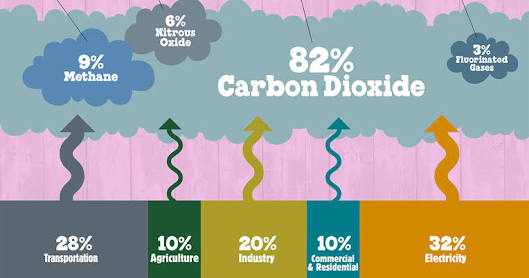
The greenhouse effect causes the atmosphere to retain heat
When sunlight reaches Earth’s surface, it can either be reflected back into space or absorbed by Earth. Once absorbed, the planet releases some of the energy back into the atmosphere as heat (also called infrared radiation). Greenhouse gases like water vapor (H2O), carbon dioxide (CO2), and methane (CH4) absorb energy, slowing or preventing the loss of heat to space. In this way, GHGs act like a blanket, making Earth warmer than it would otherwise be. This process is commonly known as the “greenhouse effect.”
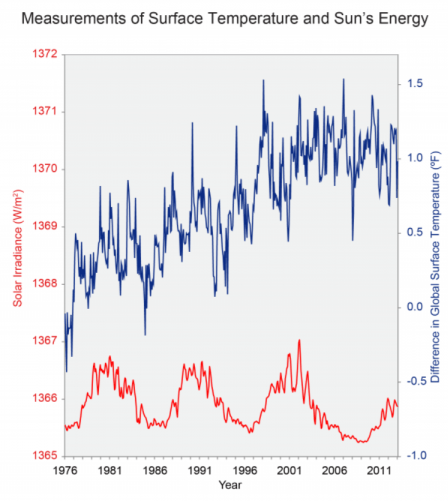
Changes in the sun’s energy affect how much energy reaches Earth’s system
Climate is influenced by natural changes that affect how much solar energy reaches Earth. These changes include changes within the sun and changes in Earth’s orbit.
Changes occurring in the sun itself can affect the intensity of the sunlight that reaches Earth’s surface. The intensity of the sunlight can cause either warming (during periods of stronger solar intensity) or cooling (during periods of weaker solar intensity). The sun follows a natural 11-year cycle of small ups and downs in intensity, but the effect on Earth’s climate is small.[1]
Changes in the shape of Earth’s orbit as well as the tilt and position of Earth’s axis can also affect the amount of sunlight reaching Earth’s surface.
Changes in reflectivity affect how much energy enters Earth’s system
When sunlight reaches Earth, it can be reflected or absorbed. The amount that is reflected or absorbed depends on Earth’s surface and atmosphere. Light-colored objects and surfaces, like snow and clouds, tend to reflect most sunlight, while darker objects and surfaces, like the ocean, forests, or soil, tend to absorb more sunlight.
The term albedo refers to the amount of solar radiation reflected from an object or surface, often expressed as a percentage. Earth as a whole has an albedo of about 30%, meaning that 70% of the sunlight that reaches the planet is absorbed.[3] Absorbed sunlight warms Earth’s land, water, and atmosphere.
Ways on how to suppress climate change.
Power your home with renewable energy.
Choose a utility company that generates at least half its power from wind or solar and has been certified by Green-e Energy, an organization that vets renewable energy options. If that isn’t possible for you, take a look at your electric bill; many utilities now list other ways to support renewable sources on their monthly statements and websites.
Invest in energy-efficient appliances.
Since they were first implemented nationally in 1987, efficiency standards for dozens of appliances and products have kept 2.3 billion tons of carbon dioxide out of the air. That’s about the same amount as the annual carbon pollution coughed up by nearly 440 million cars. “Energy efficiency is the lowest-cost way to reduce emissions,” Haq says. When shopping for refrigerators, washing machines, and other appliances, look for the Energy Star label. It will tell you which are the most efficient.
Reduce water waste.
Saving water reduces carbon pollution, too. That’s because it takes a lot of energy to pump, heat, and treat your water. So take shorter showers, turn off the tap while brushing your teeth, and switch to WaterSense-labeled fixtures and appliances. The EPA estimates that if just one out of every 100 American homes were retrofitted with water-efficient fixtures, about 100 million kilowatt-hours of electricity per year would be saved—avoiding 80,000 tons of global warming pollution.

 Climate Change